Devon Schröder · 1 October 2026
Decoding Link Profile Transformations Through Timestamped Migration Records
Timestamped migration records provide a structured way to track how link profiles evolve when websites undergo domain changes or server relocations, and researchers have documented these patterns through archival data that captures backlink acquisitions and losses at precise intervals. These records combine crawl timestamps with migration logs to reveal shifts in anchor text distributions, referring domain authority, and link velocity that occur before and after a site moves to a new address. Observers note that such documentation helps separate natural link decay from migration-induced disruptions, while data from multiple web archives shows consistent clusters of link transformations appearing within 30 to 90 days of recorded move events.
Core Components of Timestamped Migration Documentation
Link profile analysis relies on three intersecting data layers: the original crawl dates from search engine indexes, the exact timestamps of DNS changes or content transfers, and the subsequent re-crawls that register new or broken links. Experts have observed that when these layers align, patterns emerge such as sudden spikes in low-quality links from previously unrelated domains or abrupt drops in high-authority references that once pointed to the old URL structure. Studies indicate these transformations often follow predictable sequences because search engines re-evaluate link equity during the period when both old and new addresses coexist in indexes.
One documented approach involves cross-referencing Internet Archive snapshots with server log entries to isolate the moment a migration begins and ends. This method allows analysts to measure how many external links update automatically through 301 redirects versus how many remain pointing at error pages, and figures from large-scale crawls reveal that roughly 40 percent of referring domains fail to update within the first six months unless manual outreach occurs.
Revealing Velocity and Anchor Shifts
Link velocity calculations gain precision when migration timestamps mark the starting point for measurement, because analysts can then compare pre-move acquisition rates against post-move rates without conflating the two periods. Research indicates that domains experiencing clean migrations often show a temporary dip in new link creation followed by a recovery phase that can last several months, whereas incomplete migrations correlate with sustained negative velocity as broken links accumulate. Anchor text distributions also transform in measurable ways, with exact-match commercial phrases sometimes decreasing in favor of branded or naked URL variants once the new domain establishes its own indexing footprint.
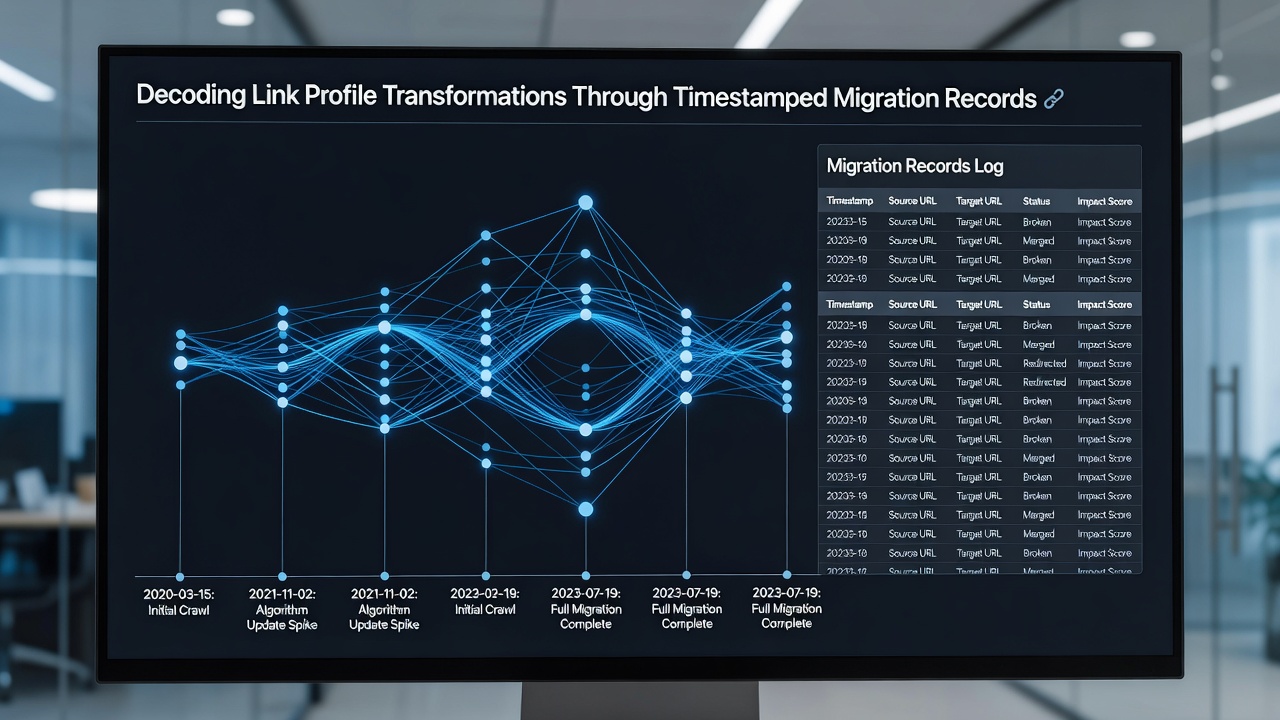
Those who have examined multiple migration events note that timestamp granularity matters; daily logs capture broad trends while hourly records expose short-lived link flurries that coincide with announcement posts or press coverage of the domain change. Data shows these flurries frequently introduce links from news outlets and industry blogs that later become stable referring domains, contributing to long-term profile strength when preserved through proper redirect implementation.
Practical Applications in Performance Tracking
Professionals apply timestamped migration records to diagnose ranking fluctuations that appear weeks or months after a site move, because the records pinpoint whether lost links or new toxic links coincide with the observed changes. According to reports from the Library of Congress digital preservation initiatives, archived snapshots have helped reconstruct link histories for government sites that underwent multiple relocations, revealing how legacy .gov domains retained authority through careful timestamp-aligned redirect strategies. Similar techniques appear in academic studies where researchers reconstruct historical link graphs to understand how institutional websites maintained visibility despite infrastructure updates.
Tools that ingest both migration timestamps and link data can generate timelines showing the exact dates when specific referring domains stopped passing equity or when new domains began contributing links. These timelines support segmentation of the link profile into pre-migration, transition, and stabilization phases, each with distinct characteristics that influence overall domain metrics tracked by major search engines.
Challenges in Data Integration
Integrating timestamped records across different sources introduces inconsistencies because crawl frequencies vary and some archives retain fewer snapshots during low-traffic periods. Analysts address these gaps by weighting available data points according to crawl density and by supplementing with server-side logs that record the precise moment redirect rules activate. Evidence suggests that combining multiple independent archives reduces blind spots and produces more reliable transformation maps, particularly for high-value domains that attract frequent crawling.
October 2026 brought expanded API access to several national web archives, enabling finer timestamp queries that improve migration analysis for recent events. This development has allowed researchers to examine link profile behavior during migrations that occurred within the previous 18 months with greater accuracy than earlier datasets permitted.
Conclusion
Timestamped migration records function as diagnostic instruments that clarify how link profiles respond to domain and infrastructure changes, and continued refinement of archival access supports increasingly detailed reconstructions of these transformations. Organizations that maintain comprehensive logs alongside external crawl data position themselves to identify and address profile disruptions before they compound into lasting visibility issues.